
Introduction: The Hidden World of Specialized Software
We’ve all felt it: the slow, tedious grind of manual data entry. Whether it’s filling out forms or organizing paperwork, the process can feel like a major bottleneck, especially in industries like travel that run on complex documentation for visas and tours. But what if we could learn powerful, universal lessons about efficiency by looking at a tool built for a very specific job?
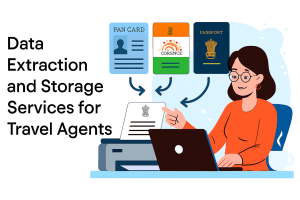
By examining a highly specialized application called DocScan.in, designed for travel agents and visa businesses, we can uncover surprisingly broad principles about automation, workflow design, and the future of work. This tool does more than just scan documents; its design reveals four impactful takeaways about how to build truly effective automated systems.
- A Single Document Becomes the “Master Key” for Everything
The first thing you notice about DocScan.in is a strict, unskippable rule: users must scan a traveler’s passport before scanning any other document, such as a PAN or Adhaar card. This isn’t an arbitrary step; it’s a foundational design choice. After the passport is scanned, all other documents for that individual are saved using the passport number as the primary reference.
This “passport as master key” approach is a powerful lesson in data integrity. It establishes a single, authoritative “source of truth” for each traveler. This simple constraint prevents duplicate records, eliminates ambiguity, and ensures that all related paperwork—from visa applications to tour manifests—is centrally and correctly linked to a specific person. It’s a simple rule that builds a robust and reliable system from the ground up.
- Automation Is About the Entire Workflow, Not Just One Task
The real power of DocScan.in isn’t just its ability to extract text from an image. Its true value comes from integrating that single action into a complete business process. It’s not just a scanner; it’s a workflow engine. Evidence of this is found in several key features:
- Tour Management: Agents can create and define specific tours, such as “Thailand 4 days,” and directly associate each scanned document with the correct tour group.
- Data Consolidation: All scanned data for a particular tour can be instantly downloaded into a single, organized Excel file, ready for use.
- Specialized Reporting: The system moves beyond generic data dumps. It generates specific reports formatted for visa applications and can even produce the “bank LRS form required by your bank for foreign remittance.”
This demonstrates a critical principle: true efficiency comes not from isolated tasks, but from a unified chain of actions where data captured in a single passport scan flows seamlessly into tour manifests, consolidated Excel reports, and even specialized financial documents like the bank LRS form.
- The Best Automation Simplifies Life for the Customer, Not Just the Business
A standout feature of the platform is its “Visa Menu” functionality, which extends the benefits of automation beyond the travel agency and directly to the end customer. After an agent scans a client’s passport, they can generate a unique link for a visa application form and send it directly to the customer. Presently it is designed for China visa application for Kailash Mansarovar tours.
When the customer opens the link, they are prompted to enter their passport number. Once they do, the form instantly pre-fills with all the data previously extracted from their passport scan, leaving them to complete only the remaining fields. This is a brilliant example of user-centric design. Automation shifts from being a purely back-office tool for the agent’s benefit to a customer-facing convenience that saves time, reduces errors, and improves the overall experience.
- Even with 98% Accuracy, the Final Check Is Still Human
The platform states that its scanner achieves 98% accuracy. However, it doesn’t leave that final 2% to chance. After every scan, the system enforces a mandatory step: “Confirm the results.” The instructions are explicit and clear. The user must carefully check each field, verifying the exact spelling of the name, the passport number, and all critical dates. If any field is incorrect, the agent can manually edit it before saving.
This highlights the practical reality of automation in high-stakes environments. For critical data like passport details, where a small error can lead to a cancelled trip, technology is a powerful assistant, not a complete replacement. It does the heavy lifting, but human oversight remains the essential final step to guarantee 100% accuracy and prevent costly mistakes.
Conclusion: A Smarter Way to Work
By looking closely at a niche tool, we’ve uncovered four powerful lessons in system design: establish a single source of truth, automate the entire workflow, extend benefits to the customer, and always keep a human in the loop for critical validation. These principles aren’t just for travel agents; they provide a blueprint for anyone looking to implement smarter, more effective automation.
As automation becomes more common, what is the right balance between machine efficiency and essential human judgment?